Want a heads up when a new story drops? Subscribe here.
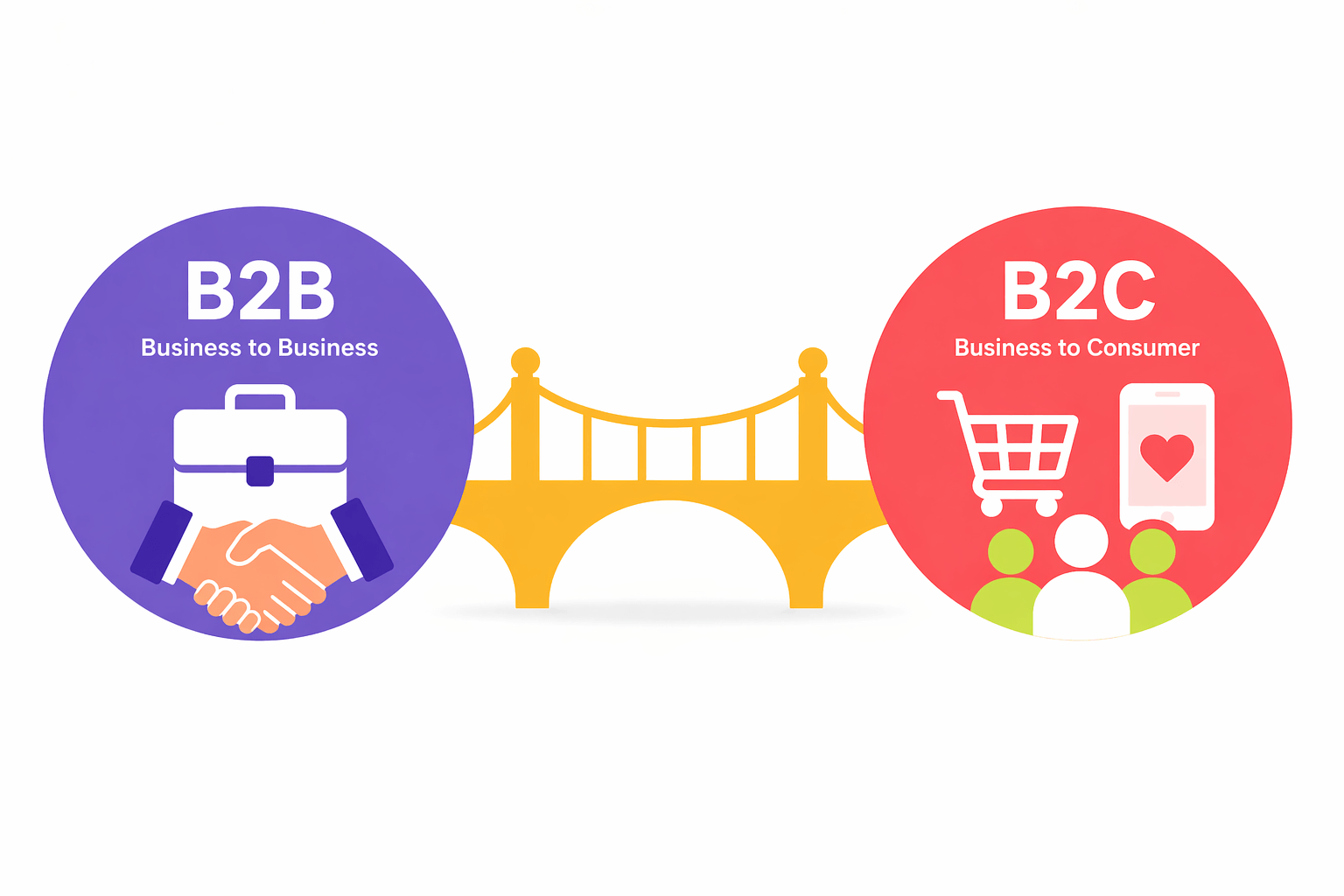
Stop treating B2B and B2C social media like they are the same thing with different logos. They are not. The audience is different, the buying decision is different, the content that moves people to act is different, and the platforms that matter are different. Brands that ignore this distinction spend money on social media for years and wonder why the results never match the effort. The answer is usually that they borrowed a B2C playbook for a B2B audience, or they ran buttoned-up B2B content at a consumer who just wanted to be entertained.
This guide is the honest breakdown of what actually works for B2B and B2C social media in 2026. Not the theoretical version. The version built from watching real campaigns succeed and fail, from studying what the platforms reward right now, and from understanding how social media fits into a buying journey that has gotten more complex, not less, as AI tools and short-form video have reshaped how people consume content and make decisions.
If you run marketing for a business, manage a brand’s social presence, or own a company that is trying to figure out where social media fits in your growth strategy, this is the breakdown you need.
Table of Contents
The Fundamental Difference Between B2B and B2C Audiences on Social Media
The most important thing to understand about B2B versus B2C social media is not the platform or the format. It is the buying decision. Everything else flows from there.
A B2C buyer sees something, wants it, and buys it. The cycle can be minutes. The emotional trigger is immediate. The decision is often individual and impulsive. The content that works in this environment is content that creates desire, builds identity, and makes the purchase feel obvious and low-risk right now.
A B2B buyer sees something, takes it to a meeting, gets budget approval, involves legal, waits for the next quarter, and buys it six months later. Sometimes twelve months later. The cycle is long. The decision involves multiple people. The emotional trigger is professional confidence and risk reduction. The content that works in this environment is content that makes the buyer look smart for recommending you and feel safe about advocating for your brand internally.
Why This Distinction Changes Everything About Your Content Strategy
When you understand the buying cycle difference, the content strategy difference becomes obvious. B2C content needs to create a feeling fast. It needs to stop the scroll, spark desire, and connect emotionally in under three seconds. The job of B2C social media is to compress the distance between awareness and desire.
B2B content needs to build a case slowly. It needs to demonstrate expertise, establish credibility, and give the buyer the language and evidence they need to make the case internally. The job of B2B social media is to be the most trusted voice in your category so that when the budget conversation happens, your brand is already the obvious choice.
Neither of these is a superior strategy. They are appropriate strategies for fundamentally different buying realities. Getting them confused is expensive.
Platform Strategy by Business Type: Where B2B Wins, Where B2C Wins
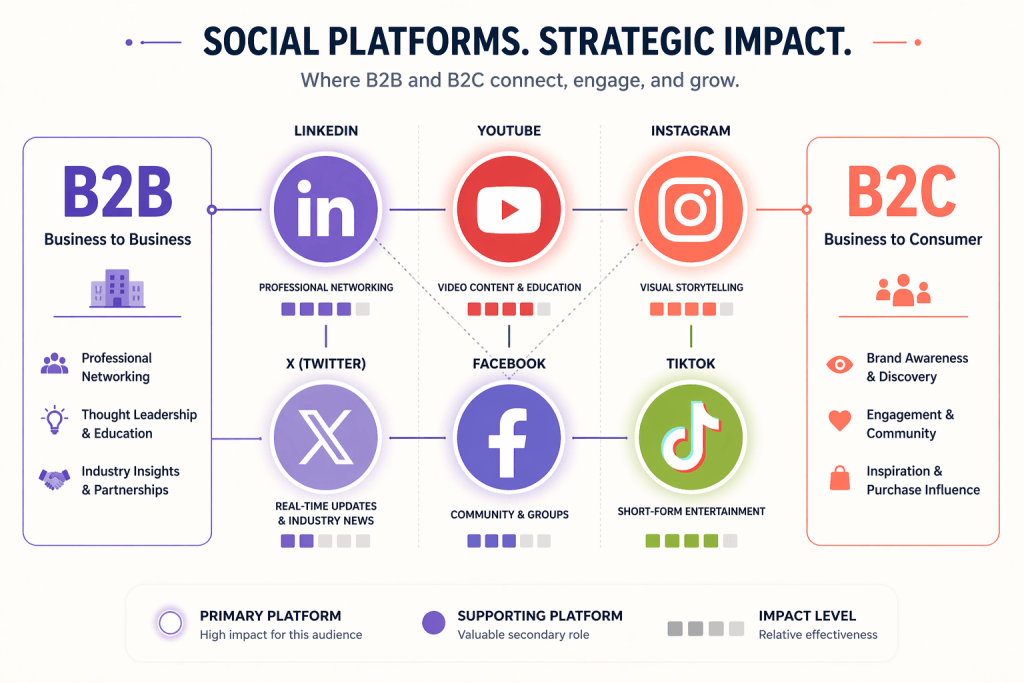
Platform choice is not a preference. It is a strategic decision based on where your specific buyer spends time and what mental state they are in when they get there.
LinkedIn in 2026: Still the B2B Standard, But It Has Changed
LinkedIn remains the primary B2B social platform in 2026, but the LinkedIn that works today is meaningfully different from the LinkedIn of three years ago. The algorithm has shifted heavily toward personal content from individual voices rather than corporate page posts. A post from your CEO, your sales director, or your lead strategist sharing a genuine professional opinion will consistently outperform the same content posted from your company page.
This is not a small difference. Personal LinkedIn posts from credible professionals in a given industry regularly reach tens of thousands of relevant people organically. Company page posts from the same organization reach hundreds. If your B2B social strategy is built around publishing content to your company page and calling it LinkedIn marketing, you are leaving the vast majority of the platform’s value on the table.
The content formats that are working on LinkedIn in 2026 are text-based posts that take a clear position on an industry topic, short-form video from individual contributors sharing expertise or behind-the-scenes perspective, carousels that walk through a framework, process, or data set visually, and long-form articles that establish genuine thought leadership on specific topics.
What is not working: generic company announcements, reposted press releases, stock photography with motivational quotes, and content that reads like it was written by a committee trying to offend nobody.
Instagram in 2026: B2C Primary, B2B Supporting
Instagram remains the dominant B2C visual platform in 2026, but its role has evolved significantly from the highly curated feed aesthetic that defined it from 2015 to 2021. The platform now rewards authenticity, relatability, and entertainment far more than production value alone.
For B2C brands, Instagram in 2026 is a three-layer platform. Reels drive discovery, reaching people who do not follow you yet through the algorithm. Stories maintain relationship with existing followers through behind-the-scenes, polls, and daily touchpoints. Feed posts build the brand reference library that new visitors browse when deciding whether to follow or buy.
The B2C brands winning on Instagram in 2026 are the ones that have figured out how to be genuinely interesting in short-form video, not just visually attractive in static images. This requires a different creative muscle than traditional brand photography, and many established B2C brands are still catching up to creators and direct-to-consumer brands that built this capability first.
For B2B brands, Instagram plays a supporting role. It humanizes the company, shows culture and team, and builds the kind of employer brand that attracts talent. It is rarely a primary lead generation channel for B2B, but its absence is noticeable to prospects who check it as part of their due diligence on a vendor they are considering.
Facebook in 2026: The Underestimated Channel
Facebook gets dismissed constantly in marketing conversations, usually by people in their 30s who have stopped using it personally and assume everyone else has too. The data does not support this. Facebook remains the largest social network in the world by active users, and its advertising platform remains the most sophisticated targeting system available to marketers at any budget level.
For B2C brands targeting consumers over 35, Facebook is still a primary channel that deserves serious investment. For B2B brands running retargeting campaigns or targeting specific professional demographics, Facebook’s ad platform, particularly combined with Instagram through Meta’s unified ad manager, delivers reach that LinkedIn cannot match at a fraction of the cost per impression.
The organic reach on Facebook has declined significantly over the past five years, and brands that depend on organic Facebook posts for significant reach are going to be disappointed. The platform has become primarily a paid media vehicle for most business purposes. That is not a failure of the platform. It is just the reality of how it monetizes, and building your Facebook strategy around that reality produces better results than fighting it.
TikTok and YouTube: Where B2C Discovery Happens at Scale
TikTok and YouTube Shorts have become the discovery engines for B2C brands that know how to use them. The algorithmic reach available on TikTok in particular is unlike anything else in social media. A brand account with zero followers can publish a video today and have it seen by a million relevant people tomorrow if the content connects with the algorithm’s signals.
The catch is that the content has to be genuinely good at the TikTok format, which is entertainment first and brand message second. B2C brands that try to bring traditional advertising sensibility to TikTok consistently underperform brands that invest in creators and formats native to the platform. The production value that works is lo-fi and authentic, not polished and corporate.
For B2B brands, YouTube is the long-form video platform worth investing in. Tutorials, case studies, webinar recordings, and expert interview series build searchable libraries of content that compound in value over time. YouTube is the second largest search engine in the world. B2B content that answers the questions your buyers are asking before they contact a vendor generates inbound interest months and years after it is published.
Content Formats That Work for B2B in 2026
The B2B content formats that are generating real results in 2026 share one characteristic: they demonstrate expertise without hiding behind corporate language.
Thought Leadership That Actually Takes a Position
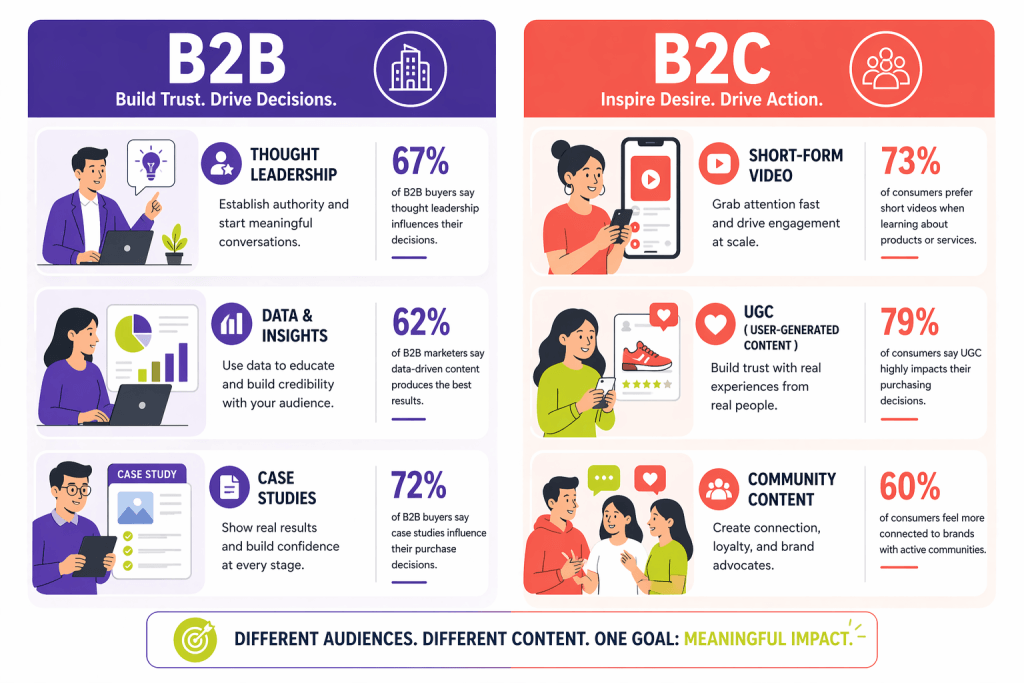
The most effective B2B social content in 2026 is content from people, not brands, that takes a genuine position on something relevant to the industry. Not “here are five things to consider about your marketing strategy.” That hedges everything. Something more like “most agencies are selling you AI tools when what you actually need is an AI strategy, and here is the difference.”
Positions create conversation. Conversation creates reach. Reach creates awareness among buyers who were not looking for you. This is how B2B social media generates pipeline without running ads, and it is why the brands investing in executive and practitioner voices on LinkedIn are consistently outperforming the ones posting corporate content from brand accounts.
Data and Research Content
Original data is one of the most shareable content formats in B2B social. Survey results, benchmark reports, and proprietary research give your audience something they cannot get anywhere else and position your brand as a credible source of market intelligence. Even small-scale surveys of your own client base or your network can produce data points that travel widely when packaged well.
Case Studies Told as Stories
The traditional B2B case study is a problem-solution-result document that reads like a legal brief. It convinces nobody. The case study format that works on social in 2026 is the story version: what was actually happening in the client’s business, what they tried before they found you, what the turning point was, and what changed. Real names, real numbers, real moments. If your clients will allow it, this format generates more qualified inbound inquiries than almost any other B2B content type.
Content Formats That Work for B2C in 2026
B2C social content in 2026 is competing in the most crowded content environment in history. The formats that cut through share one quality: they make the viewer feel something within the first two seconds.
Short-Form Video With a Hook That Earns Attention
The first second of a short-form video is the only second that matters initially. If the viewer does not feel something, whether that is curiosity, recognition, humor, or surprise, they swipe. The best B2C short-form video in 2026 opens with a hook that either states a problem the viewer has or shows them something they have never seen before.
Production value matters less than the idea. A shaky phone video with a great hook outperforms a polished brand film with a slow build every time on TikTok, Instagram Reels, and YouTube Shorts. This is hard for established brands to accept, but the data is unambiguous.
User Generated Content and Creator Partnerships
The most trusted content in B2C social media in 2026 is content that does not look like it came from a brand. User generated content, real customers sharing real experiences, and creator content, people with genuine audiences sharing authentic perspectives, consistently outperforms brand-produced content on reach, engagement, and conversion metrics.
The brands getting this right are not paying influencers to read scripts. They are finding creators whose audiences align with their buyer, giving them the product or experience, and letting them react authentically. The creative control trade-off is real. The results are consistently better than scripted brand content.
Community-Building Content
The B2C brands with the most durable social media presence in 2026 have built communities, not just audiences. They create content that brings their customers together around a shared identity, shared values, or shared experiences rather than content that just promotes their products. The purchase becomes a byproduct of the belonging, not the other way around.
Budget Allocation: How B2B and B2C Should Split Paid vs Organic in 2026
This is where strategy meets reality, and the honest answer is that both B2B and B2C social media require paid amplification to scale beyond your existing audience in 2026. Purely organic strategies have a ceiling that most growing businesses hit quickly.
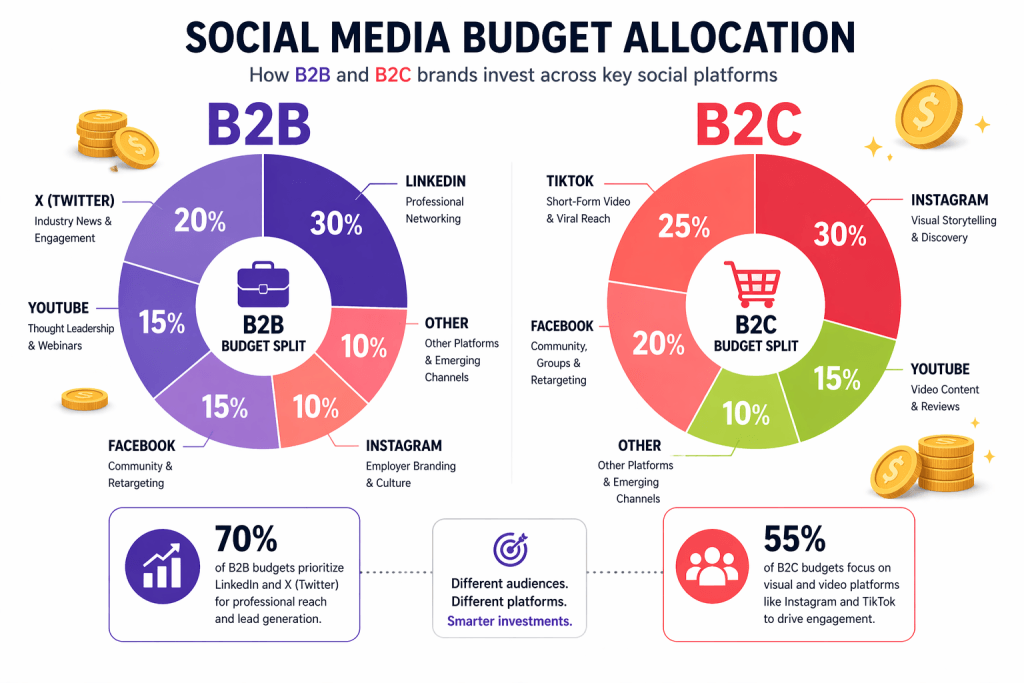
For B2B brands, the recommended split is roughly 60 percent of social budget on LinkedIn, primarily through Sponsored Content and Lead Gen Forms targeting specific job titles and industries, 25 percent on retargeting through Meta targeting website visitors and email list matches, and 15 percent on experimental spend testing emerging formats and platforms.
For B2C brands, the split depends heavily on the product category and average order value. Consumer brands with lower price points and impulse purchase dynamics typically allocate 50 to 60 percent to Meta advertising, which offers the most sophisticated audience targeting and measurement available at scale. The remaining budget splits between TikTok for discovery, YouTube for consideration-stage content, and platform-specific formats like Pinterest for categories where visual inspiration drives purchase intent.
The variable that most brands underinvest in across both B2B and B2C is the creative production budget. You can have perfect targeting and a mediocre creative and the campaign will underperform. Allocating 20 to 25 percent of total social budget to content creation rather than media spend is not excessive. It is the investment that makes the media spend work.
How Socialfix Builds Social Media Strategy for B2B and B2C Brands
At Socialfix, we work across both B2B and B2C, and the lesson we have learned from 20 years of doing this is that the strategic starting point is always the same: understand the buying decision before you decide anything about content or platform.
We start every social media engagement with a buyer journey audit. We map who is making the purchase decision, what they need to believe before they buy, where they spend time online, and what content formats they actually respond to. Everything we build comes from that foundation.
For B2B clients, we typically lead with LinkedIn strategy built around individual voices in the organization, supported by a paid media strategy that keeps the brand in front of target accounts through the long consideration cycle. For B2C clients, we lead with short-form video strategy and creator partnerships, supported by Meta advertising that converts the awareness those formats generate into measurable revenue.
What we do not do is apply the same playbook to every client regardless of their business model. The agencies that do are the ones that produce impressive-looking social media presence that does not move the business metrics that actually matter.
If you want a social media strategy built around your specific buyer and your specific growth goals rather than a generic content calendar, connect with our team at socialfix.com. We will show you exactly what we would do and why.